Bedroom4 min read
The Bedroom Audit for Cooler Nights in Menopause
Check bedding, clothing, air, light and noise one step at a time. Cooler is about your own comfort—not a universal temperature target.
Read article
Bedroom · 4 min read
Separate covers and removable layers can give two sleepers more choice. Start a comfort conversation without demanding one room setting.
By Her Again · Published October 25, 2026
When searching for “menopause sleep partner temperature different,” you may really be asking: how can we share a bed without arguing over the covers? Separate covers, removable layers and a calm daytime conversation can give each person more choice. They do not guarantee sleep, but they may make adjustments simpler.
There is no universal bedroom temperature in this guide. If you want to cool the room, try a few degrees cooler than where you are now, toward your own comfort range, while considering your partner and your home. The NHS suggests lightweight clothing and a cool bedroom as practical comfort measures.
Your partner may feel comfortable under a thick cover while you want it off. That is a practical mismatch, not proof that either of you is unreasonable. Talk at a time when neither is tired or trying to get back to sleep.
Describe the task rather than blame: “I need to remove a cover quickly when I wake hot” is easier to work with than “You make the bed too warm.” Ask what your partner needs too.
The goal is not to force one shared setting. It is to find choices that each person can adjust with less fuss.
Use two covers already in the home if possible. Your partner can keep a warmer layer while you use a lighter one. Check that they sit comfortably on the bed and are easy to move.
Separate covers may feel unfamiliar at first. Try them for comfort rather than judging how the bed looks. If they are awkward, you can change the arrangement. This is a household experiment, not a rule you must keep.
You may prefer a shared sheet with different top layers, or two independent bedding sets. There is no required combination.
A dry top and removable cover can help you respond without pulling every blanket off the bed. Keep essentials on your side so you do not need to reach across a sleeping partner.
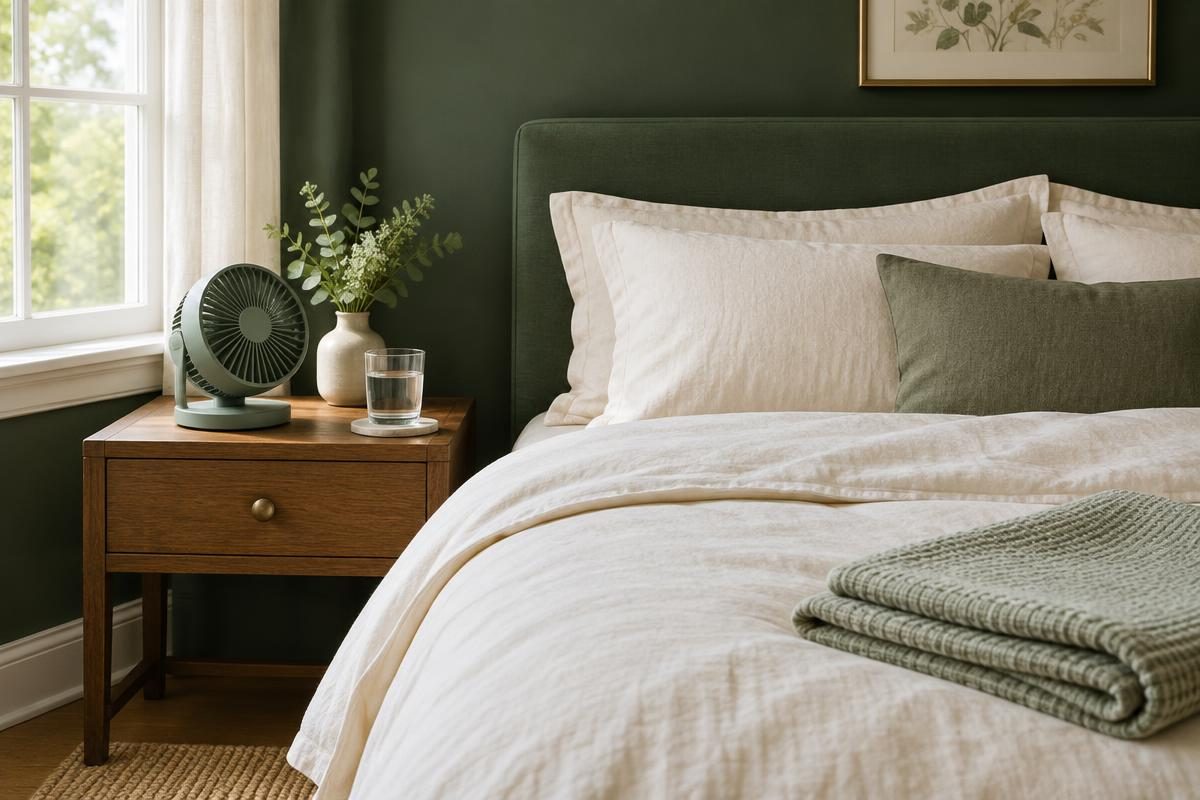
If you use a fan, discuss noise and airflow before bedtime. Try a position that gives you control without directing air where your partner finds it uncomfortable. Keep cords out of the walking path.
For more options, read the bedroom audit and the night-time recovery kit.
In the morning, ask whether adjusting your side was simpler. Did you find a dry top without searching? Could your partner keep a warmer layer? These are practical outcomes, not proof of a medical benefit.
If the room changed at the same time as the bedding, note that. It may be hard to tell which mattered. You do not need a perfect experiment to decide that an arrangement is more convenient.
Some couples may occasionally prefer separate sleeping spaces. That is a personal household choice, not a recommendation that every couple needs to do so. Discuss what feels workable and respectful.
A partner-friendly bed cannot identify why you sweat or wake. Regular night sweats that wake or worry you deserve advice, as described in NHS night-sweat guidance. Mention other symptoms, medicines and daily impact.
Ask about HRT and non-hormonal options when appropriate. A practical bedding change can sit alongside medical care; it is not a replacement for symptom treatment.
No. The aim is flexible comfort, not an extreme temperature. Start with separate layers before changing the whole room.
This article does not require a purchase or claim that a particular fabric treats symptoms. Begin with comfortable, manageable options you already have.
Change the setup or leave it. A household experiment can be useful even when it shows that a choice does not fit you.
Educational information only, not medical advice. Talk to your doctor about your own symptoms and treatment options, including HRT and non-hormonal options.
Explore Her Again’s educational ebook and journal with The Night Reset Collection — $47 one-time, with permanent access to your purchased files. The Complete Night Reset Blueprint — $97 one-time — adds the private interactive four-week Blueprint and initial 30 days of Ask Her Again AI, up to 100 messages. No lifetime AI access and no automatic subscription.
All purchases of the $47 Night Reset Collection and $97 Complete Night Reset Blueprint are final sale and nonrefundable, except where refunds are required by applicable law or the payment platform’s policies.
Check bedding, clothing, air, light and noise one step at a time. Cooler is about your own comfort—not a universal temperature target.
Read article
Regular periods do not explain or rule out every sleep symptom. Learn what to record and what to ask before assuming the cause.
Read articleA few morning notes can help you describe your nights. Track symptoms and context without scoring yourself or trying to diagnose a cause.
Read article