Bedroom4 min read
Partner Wants It Warm, You Need It Cool: Sleep Layers That Work
Separate covers and removable layers can give two sleepers more choice. Start a comfort conversation without demanding one room setting.
Read article
Bedroom · 4 min read
Check bedding, clothing, air, light and noise one step at a time. Cooler is about your own comfort—not a universal temperature target.
By Her Again · Published October 25, 2026
A bedroom audit for cooler nights in menopause is a check of what you can change around the bed: layers, clothing, air, light and noise. Start with the thing that feels least comfortable. You do not need a perfect room, a new mattress or one exact temperature.
If you choose to cool the room, try a few degrees cooler than where you are now, toward your own comfort range. The NHS suggests a cool bedroom and lightweight clothing, but that does not establish a single temperature that works for everyone. These steps support comfort, not a promise to stop sweats.
Look at the layers you use at bedtime. Is the heaviest one needed all night? Could you fold part of it back or use a lighter layer you already own? Are covers easy to move without waking your partner?
Next, look at your sleepwear. Notice how it feels rather than judging it by a label or price. If it stays damp after a sweat, set a dry top nearby. You can make a useful change without buying clothing marketed for menopause.
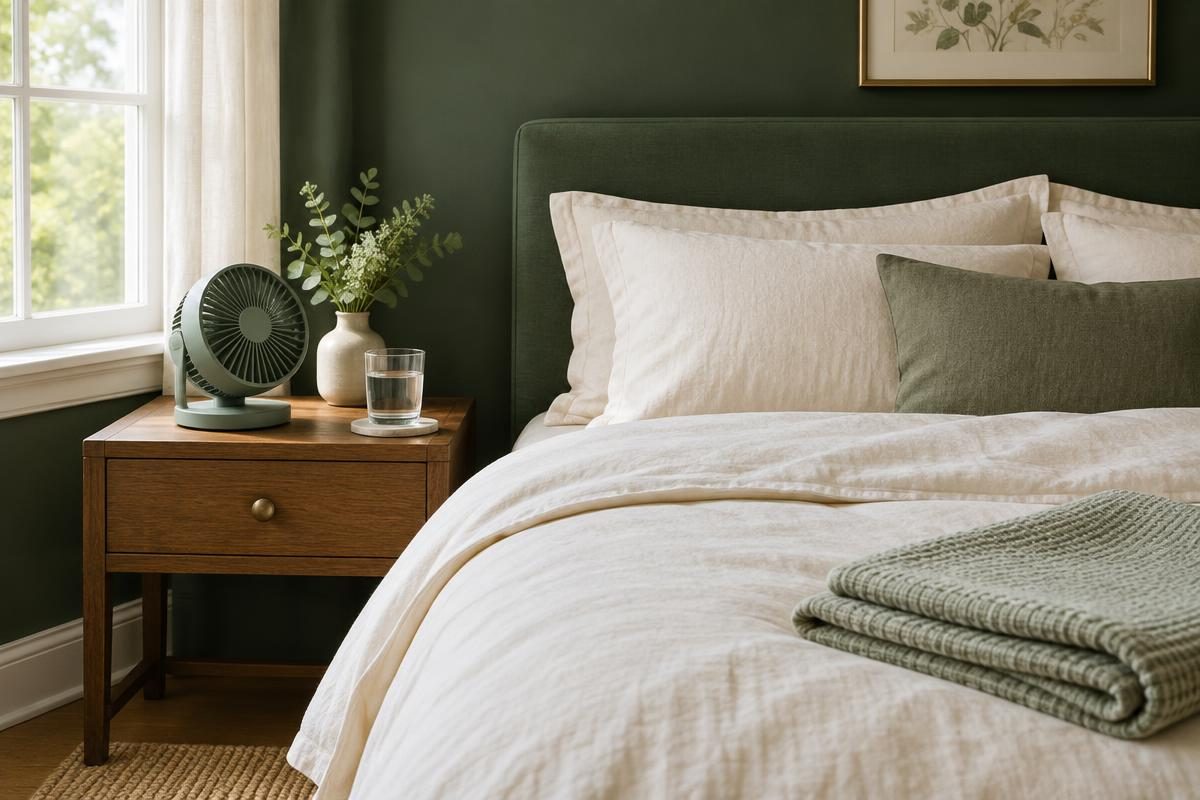
A fan may help you feel more comfortable, but it is not essential. Test where it sits, how loud it sounds and whether you can turn it down easily. Avoid placing cords where you walk during the night.
Consider what is possible in your home. Outside noise, pollen, security, local heat and energy costs may affect whether you open a window or change a thermostat. Work with those limits. A useful plan should fit real life, not ask you to ignore it.
If you share a bed, talk before making a large room change. Separate covers may give each person more choice. Read about partner-friendly sleep layers for a simple starting point.
Check whether a bright charger, screen, streetlight or sound bothers you. The NHS includes a dark, quiet bedroom in its sleep-habit guidance. Choose a manageable change: move a bright device, adjust a curtain, or lower a repeated sound where possible.
Keep enough light for safe movement. A perfectly dark room is not worth a fall. If you need to change clothing or reach the bathroom, place a light so you can see the path without searching for a switch.
Choose one item to try first. Doing all ten tonight is not required.
Write what you changed and how it felt. “Fan was too loud” is as useful as “lighter blanket felt better.” You are learning what fits your room, not proving a medical theory.
Keep your usual routine steady where practical. If the weather or work schedule also changed, note that. One better night cannot show cause and effect, and one rough night does not mean the change failed.
Use the two-minute tracker to keep observations brief. If you feel pressured by tracking, scale it down to a line or two.
A room change cannot tell you why you sweat. Menopause can be part of the picture, but night sweats may have other causes. Regular sweats that wake or worry you should be discussed with a doctor, as described in NHS night-sweat guidance.
You can use practical steps while asking about HRT, non-hormonal options and persistent sleep difficulty. Do not wait for a perfect bedroom before seeking help.
Start with removable covers, dry clothing and safe access to essentials. The audit is not a requirement to control the whole home.
It is finished enough when you have found one practical change worth trying. Revisit it when the season or your comfort changes.
Educational information only, not medical advice. Talk to your doctor about your own symptoms and treatment options, including HRT and non-hormonal options.
Explore Her Again’s educational ebook and journal with The Night Reset Collection — $47 one-time, with permanent access to your purchased files. The Complete Night Reset Blueprint — $97 one-time — adds the private interactive four-week Blueprint and initial 30 days of Ask Her Again AI, up to 100 messages. No lifetime AI access and no automatic subscription.
All purchases of the $47 Night Reset Collection and $97 Complete Night Reset Blueprint are final sale and nonrefundable, except where refunds are required by applicable law or the payment platform’s policies.
Separate covers and removable layers can give two sleepers more choice. Start a comfort conversation without demanding one room setting.
Read article
Regular periods do not explain or rule out every sleep symptom. Learn what to record and what to ask before assuming the cause.
Read articleA few morning notes can help you describe your nights. Track symptoms and context without scoring yourself or trying to diagnose a cause.
Read article